
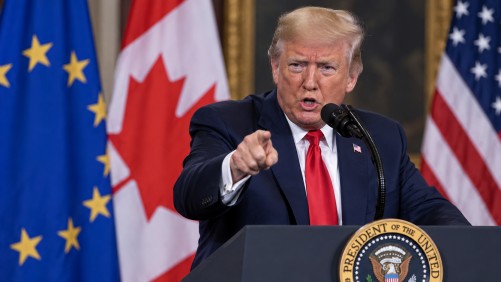
President Donald Trump has signaled potential economic retaliation against the European Union following its proposal to grant Canada an “associate member” status, a move that could strain transatlantic trade relations. Trump’s warning of “very serious tariffs” on European goods comes as a direct response to the EU’s overture to Canada, which he deems a “hostile act.”
The EU’s invitation to Canada aims to deepen cooperation in areas such as technology, defense, and energy, as both parties seek to strengthen democratic alliances amidst global challenges. European Commission President Ursula von der Leyen described the proposed partnership as an “alliance for the future,” suggesting it could extend beyond existing trade agreements to include critical sectors like artificial intelligence and cybersecurity.
While the specifics of Canada’s associate membership are still under discussion, the EU currently lacks a formal category for such a status. Nonetheless, countries like Norway, Iceland, and Switzerland maintain robust economic ties with the bloc, setting a possible precedent for this new arrangement. President Trump’s administration has previously imposed tariffs on both Canada and the EU, complicating the US’s traditional trading relationships.
Canada’s interest in broadening its defense partnerships beyond the US is evident in its recent application to join the British-led Joint Expeditionary Force, which includes 10 NATO member states. This move aligns with Ottawa’s strategy to diversify its international alliances.
The potential economic implications of Trump’s response to the EU-Canada proposal underscore the fragile nature of global trade dynamics. As Canada and the EU explore ways to enhance their partnership, the US’s reaction could have significant repercussions for transatlantic trade and diplomatic relations.