
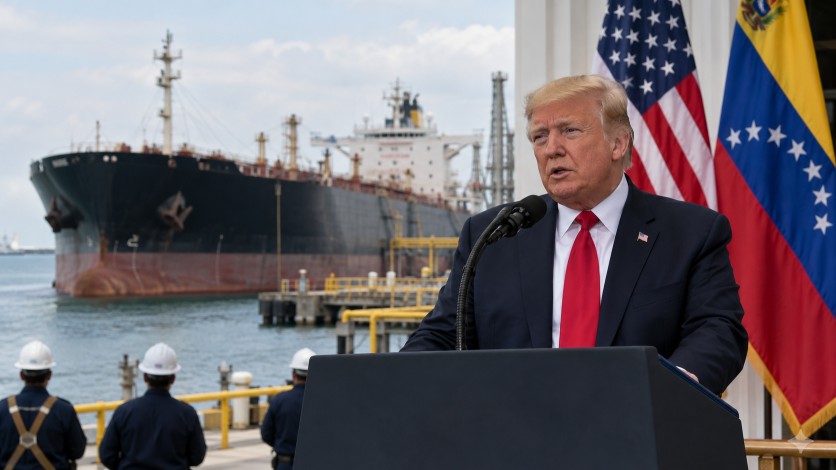
In a bold move to bolster American energy policy, President Donald Trump has announced a new oil agreement with Venezuela, describing it as a significant triumph. Speaking at a campaign rally in Corpus Christi, Texas, Trump highlighted an oil tanker off the Texas coast, purportedly carrying one million barrels of Venezuelan oil, as a testament to the deal’s success. He claimed that this shipment would not cost American taxpayers and could potentially bring billions of barrels of oil to the United States.
Trump went further, suggesting that Venezuela might one day become the 51st state of the United States, envisioning prosperity for the South American country under this new arrangement. The agreement was achieved with Venezuela’s interim government after a US military operation in January led to the capture of former President Nicolás Maduro, who was then taken to New York to face criminal charges.
The deal is being touted as a strategy to enhance US energy dominance and alleviate domestic fuel prices, especially as tensions with Iran have disrupted oil shipments through the vital Strait of Hormuz. These disruptions have contributed to rising energy prices, placing additional pressure on consumers.
Despite the positive outlook presented by Trump, the agreement has faced criticism concerning Venezuela’s political future. Critics argue that the US administration has prioritized access to Venezuelan oil over ensuring a democratic transition in the country, which has not held elections since Maduro’s detention by US forces.
While Trump is promoting the Venezuelan oil agreement as a key element of his energy strategy, questions remain about its long-term economic impact and whether it will significantly reduce fuel prices in the United States. Additionally, concerns linger over the stability and future governance of Venezuela in the wake of these developments.